KYC at crypto casinos, when they ask for ID and how to avoid a frozen withdrawal
Why even "no KYC" crypto casinos can ask for your ID, when it usually happens, which documents they want, and simple steps that keep your withdrawal from getting stuck.

What KYC means, in plain words
KYC stands for know your customer. It’s the casino checking that you are who you say you are.
Think of it like a bank. You can walk in and look around without showing anything. But before they hand you a large sum of cash, they want to see your ID. Casinos work the same way, and crypto casinos are no exception.
A KYC check usually means three things.
- Proving your identity, with a passport, ID card or driving licence.
- Proving where you live, with a recent bill or bank statement.
- Sometimes proving where your money comes from, called source of funds.
Why casinos ask for ID at all
It’s not just to annoy you. There are real reasons, and some of them protect you too.
- Money laundering rules. Licensed casinos must follow anti-money laundering rules. In the EU, the rules say gambling companies must check customers on transactions of 2,000 euros or more.
- Age checks. Casinos must keep out anyone under 18.
- Fraud. ID stops people from using stolen cards, stolen wallets or someone else’s account.
- Self-exclusion. If you’ve blocked yourself from gambling, ID checks are how a casino can spot you.
- Bonus abuse. Casinos use ID to catch people who open many accounts to grab the same bonus again and again.
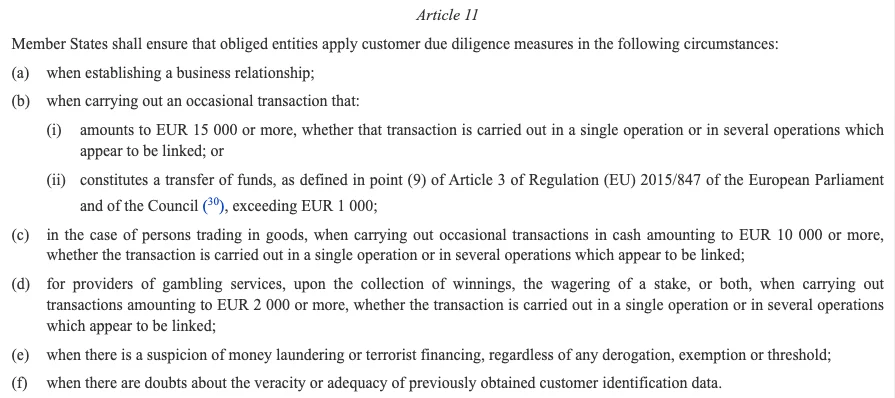
Offshore regulators, like the ones in Curaçao and Anjouan, have their own anti-money laundering rules. The details differ, but the idea is the same. A casino that pays out money must be able to show who it paid.
“No KYC” usually means “no KYC yet”
Many crypto casinos say “no KYC” in their ads. In most cases that means you can sign up and deposit without ID. It rarely means you will never be asked.
We looked at what the 11 casinos we have reviewed say. Ten of them take crypto. Here is what they say in their own terms and policies.
Not one of them promises you will never be asked for ID. Even the “light” ones keep the right to ask whenever they decide to.
- Rollbit has up to five verification levels, from personal details and photo ID to source of funds. Players report being asked at withdrawal time, especially after big wins.
- Roobet’s terms let it ask for ID whenever it wants and limit deposits and withdrawals until you send it.
- MetaWin lets you sign up with just a crypto wallet. Its policy says checks can start after large transactions, unusual activity or promotions.
- Glorbet markets itself as “No KYC”. Its terms still require a verified account to withdraw and allow it to demand notarised documents.
When the check usually happens
Here’s the trap. Most crypto casinos let you sign up, deposit and play without any questions. The check comes later, when you ask for your money.
That’s why a KYC request often feels like a surprise. You’ve won, you ask to withdraw, and suddenly the casino wants a passport, a bill and a selfie. Your money waits until you send them.
Different casinos use different triggers. Here is what the terms say at the casinos we reviewed.
| Casino | When ID is asked, in its own words |
|---|---|
| Casoo | Before a withdrawal of any amount, or once your deposits pass 2,000 euros in total |
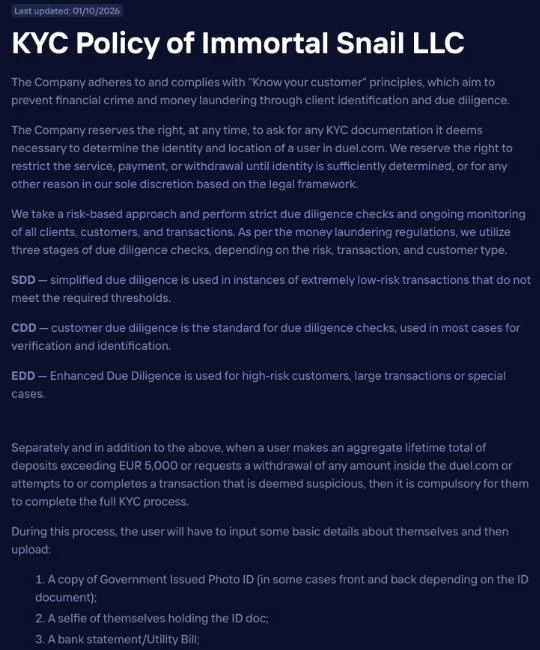
| Duel | When you ask to withdraw, once deposits pass 5,000 euros in total, or after a suspicious transaction |
| Tsars | Documents within 3 days of sign-up. Withdrawals paid only after the check |
| Yeet | Basic details before the first deposit. More after large deposits or withdrawals, or at random |
| MetaWin | Large transactions, unusual activity, limit increases or promotions. Source of funds questions from about 5 ETH a month |
| Roobet | Whenever it decides to, with limits on your account until you send the documents |
| Rollbit | Up to five levels. Players report checks at withdrawal, often after big wins |
You can read each casino’s full terms summary in our reviews of Casoo, Duel, Tsars, Yeet, MetaWin, Roobet and Rollbit.
Here is what one of these policies looks like. Duel’s says full checks become compulsory once lifetime deposits pass 5,000 euros, or when you ask to withdraw any amount.
What documents they ask for
Most casinos ask for the same small set. Here is how often each one appears in the terms and policies of the 11 casinos we reviewed.
What each one means in practice.
- Photo ID. A passport, national ID card or driving licence. All four corners visible, not expired, no glare.
- Proof of address. A utility bill, bank statement or official letter, usually no older than 3 months. The name and address must match your account.
- Selfie with your ID. A photo of you holding the same ID next to your face. It proves the ID is really yours.
- Proof of payment method. A photo of your card with the middle digits covered, or a screenshot of your e-wallet. For crypto it can mean showing that you own the wallet you used.
- Source of funds. Payslips, a tax return or bank statements that show where your gambling money comes from. This is usually only asked for large amounts.
- Video call. A short live call to match your face to your ID. EZZ Casino’s terms allow this.
How long checks take
It depends on the casino, and most don’t say. Casoo is one of the few that does. Its policy says documents are reviewed within 24 hours. Until you’re approved, you can deposit up to 500 euros in total and you can’t withdraw.
In practice, delays almost always come from the same few things.
- A blurry photo, or a corner of the ID cut off.
- A bill older than 3 months.
- A name or address that doesn’t match the account exactly.
- Sending one document, waiting, then sending the next one when asked.
- A support team that only answers once a day.
The fix for the last two is simple. When the casino asks for documents, ask support for the full list in one message. Then send everything at once.
How to avoid a frozen withdrawal
Most KYC problems can be avoided before they start. These steps cost you a few minutes.
- Read the KYC policy before your first deposit. It’s usually in the footer. Look for when checks happen and what they need.
- Sign up with your real name, date of birth and address, exactly as on your ID. A nickname or an old address is the most common cause of a failed check.
- Verify early. If the casino lets you upload documents before you play, do it. A check is quicker when no money is waiting.
- Deposit and withdraw with your own card or wallet. Never use someone else’s card, bank account or exchange account.
- Don’t use a VPN. If your login location doesn’t match your documents, many casinos treat it as a breach of the terms. Some say they can keep your balance.
- Keep your documents ready. A clear photo of your ID and a fresh bill on your phone save days.
- Expect extra checks after a big win. That’s normal at most casinos. Have your documents ready and answer quickly.
If a casino keeps asking for new documents after you’ve sent everything, or uses KYC to stall for weeks, that’s a warning sign. Our guide on what to do when a casino won’t pay explains how to complain and where to go next.
When KYC is used against players
Most casinos use KYC for the reasons above. But terms can also give a casino room to delay or refuse a payout.
- Some terms let the casino ask for any document at any time, with no limit. Duel’s policy, for example, keeps the right to restrict withdrawals “until identity is sufficiently determined”.
- Glorbet’s terms allow it to demand notarised or apostilled documents, which cost money and take time. If they don’t arrive in time, the terms let it confiscate your balance.
- Players at EZZ Casino report a withdrawal rejected for a phone check that could not be completed, even after full KYC.
Glorbet and EZZ Casino are both rated Avoid on this site. You can read why in our reviews of Glorbet and EZZ Casino.
Keep your documents safe
Sending your passport to a website is a real risk. Do it only when you’re sure who is on the other end.
- Check the licence first. Look it up on the regulator’s own website, not just the badge in the footer. Our guide on how to check a casino licence shows how.
- Never send ID to a site a regulator has warned about. The Curaçao regulator advised the public not to share personal or financial information with the GEM55 sites, for example. Read our GEM55 review.
- Upload only through the casino’s own website, while logged in. Never by Telegram, WhatsApp or a random email address.
- Watch out for fake support. Scammers pose as casino support and ask for ID to steal identities. Our report on fake casino support accounts on Telegram shows how they work.
- Cover what isn’t needed. On a card photo, cover the middle digits and never show the CVV code on the back.
- Add a note on the copy. Writing the casino’s name and the date across the image makes it harder to reuse if it ever leaks.
The short version
- “No KYC” almost always means “no KYC yet”.
- The check usually comes when you ask to withdraw, often after a big win.
- Expect photo ID and proof of address. Sometimes a selfie, payment proof or source of funds.
- Read the KYC policy, use your real details, and verify before you play big.
- Only send documents to licensed casinos, through their own site.
If gambling has stopped being fun, or you’re chasing losses while waiting for a payout, our page on responsible gambling has free tools and help lines. To compare casinos and their KYC rules side by side, start with our casino reviews.
Questions people ask
Do crypto casinos ask for ID?
Many do, at least some of the time. Of the 11 casinos we have reviewed, 6 require full ID checks and the other 5 can still ask for ID when they decide to. None of them promise that you will never be asked.
When do crypto casinos ask for KYC?
Most often when you ask to withdraw. Other common triggers are a big win, deposits passing a set total, unusual activity or a random check. Some casinos, like Tsars, ask for documents within days of sign-up.
What documents do I need for casino KYC?
Usually a photo ID such as a passport or ID card, and proof of address such as a utility bill or bank statement from the last 3 months. Some casinos also want a selfie holding your ID, proof of your payment method, or proof of where your money comes from.
How long does casino KYC take?
It varies a lot and most casinos don't publish a time. Casoo's policy says it reviews documents within 24 hours. A clear, complete upload is the best way to keep it short. Missing or blurry documents are the most common reason for long delays.
Is a no KYC casino really anonymous?
Rarely. "No KYC" usually means no ID to sign up or deposit. Most of these casinos keep the right to ask for ID later, and that usually happens when you want to withdraw. Treat "no KYC" as "no KYC yet".
Can a casino keep my money if I fail KYC?
Some terms allow it. Glorbet's terms, for example, let it confiscate a balance if you don't send the documents it asks for in time. If you think a casino is using KYC as an excuse not to pay, our guide on what to do when a casino won't pay explains the steps.
Is it safe to send my ID to a crypto casino?
Only to a casino whose licence you have checked on the regulator's own website, and only through the casino's own site. Never send ID by Telegram, WhatsApp or to an email address you can't confirm. Fake support accounts use ID requests to steal identities.