Gambling streamers, how they really make money
How casino streamers get paid, why many of them don't play with their own money, what the big deals look like, and what to keep in mind before you copy what you see.

What a gambling stream is
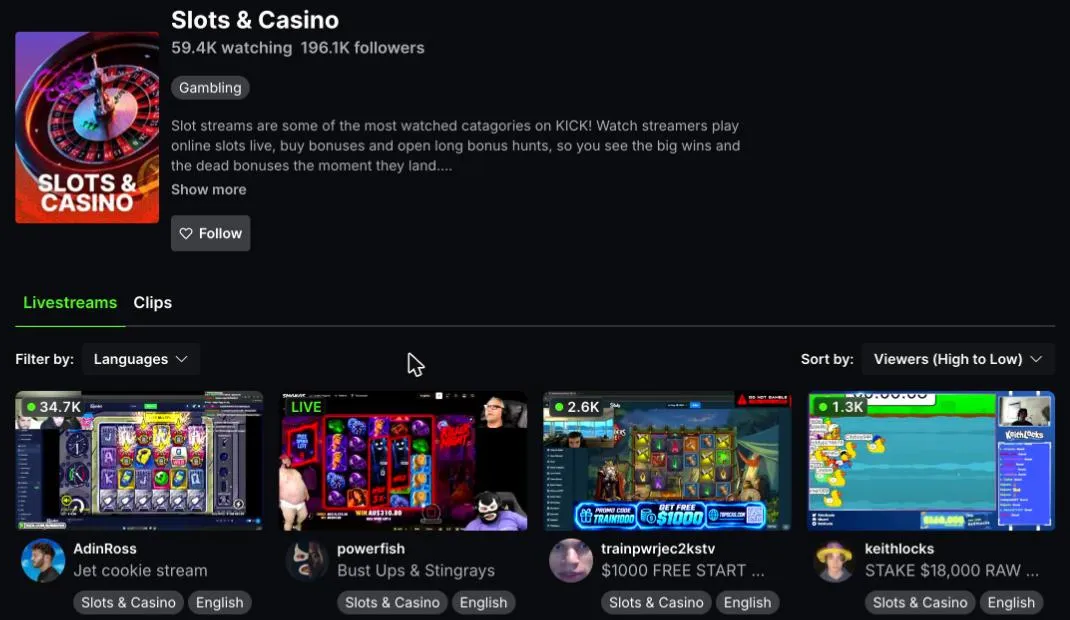
A gambling stream is a live video of someone playing casino games online. Usually slots, sometimes roulette, blackjack or crash games. Thousands of people watch at once, chat with each other and cheer on every spin.
It looks like a fun show. Big bets, loud reactions, huge wins. But behind most big gambling channels is a business deal with a casino. Once you know how that deal works, the show looks very different.
How a typical stream works
Most slot streams follow the same pattern.
- The streamer shows a big balance, often thousands or even hundreds of thousands of dollars.
- They play a run of slots, often buying bonus rounds directly instead of waiting for them.
- A “bonus hunt” is common. The streamer collects lots of bonus rounds first, then opens them one by one at the end for a big finale.
- A code or link sits on screen or in the stream title. Sign up with it and the streamer gets credit for bringing you in.
- Giveaways keep people watching. Viewers can win small amounts by staying in chat.
How streamers get paid
Here’s the simple version. Most money in gambling streaming comes from casinos, not from viewers. There are a few common ways.
| Way to earn | How it works | Who pays in the end |
|---|---|---|
| Sponsorship fee | A casino pays a set amount to stream on its site, often monthly or per stream | The casino, from its profits |
| Revenue share | The streamer gets a percentage of what referred viewers lose, often for as long as they keep playing | Viewers who lose |
| Payment per player | A one-off fee for each new player who signs up and deposits | The casino |
| House-funded balance | The casino gives or tops up the money the streamer plays with | The casino |
| Subscriptions and donations | Viewers pay the streamer directly | Viewers |
| Platform pay | The streaming site pays creators for hours or views | The platform |
Platform pay matters less than people think. Kick, the main home of gambling streams, removed its hourly creator pay for the Slots and Casino category in March 2025, according to Gambling News. So for a slots channel, the casino deal is the real income.
The revenue share problem
This is the part most viewers never hear about. With a revenue share, the streamer earns a slice of what the people who used their code lose. Not what they bet. What they lose.
Here’s what that looks like if one viewer loses 1,000 dollars. The rates below are examples only. Real deals are private and vary a lot.
Think about what that means. If you sign up with a streamer’s code and lose, the streamer gets paid. If you win and withdraw, they may earn nothing from you, and some deals subtract your winnings from what they earn later. The streamer doesn’t need to be a bad person for this to matter. The deal itself rewards them when their audience loses.
That doesn’t mean every streamer is lying to you. It means their advice on which casino to join, which bonus to take or which slot to play isn’t neutral.
Whose money is on screen
Viewers see a big balance and assume it’s the streamer’s own savings. Often that isn’t the case. Here are the setups that have been described by streamers and reporters.
- House money. The casino puts money into the account for the stream. If it’s lost, the streamer loses nothing.
- Topped-up deposits. The streamer deposits, and the casino adds extra on top as part of the deal.
- Losses covered. The streamer plays with real money, but the sponsorship fee is set to cover expected losses.
- Balances that can’t be withdrawn. Some promotional balances can be played but never cashed out. A win.gg explainer says operators in the mid-2010s were found giving streamers balances like that, and points to a balance that only climbs and is never withdrawn as a red flag.
Some streamers have been open about it. In 2023 xQc said in a stream that everybody knows he is paid to gamble, as reported by GosuGamers. In August 2025 the slot YouTuber Mr. Hand Pay said sweepstakes casinos had offered to fund his channel with millions of dollars a year if he gambled with house money while making it look like his own. He says he turned them down, Gambling News reported.
Not every streamer uses house money. Some say they play only with their own funds. The problem is that viewers usually have no way to check.
The big deals
The money at the top is enormous. These are reported figures, not confirmed contracts, so treat them as rough.
| Who | Reported amount | What we know |
|---|---|---|
| Drake | Over $100 million a year | A Stake deal reported by the Financial Times in 2023. Never confirmed by either side |
| xQc | $70 million, up to $100 million | A two-year Kick deal from 2023, widely reported. He has also said he is paid to gamble |
| Trainwreckstv | $360 million | His own claim in 2022, for about 16 months of Stake streams. Not audited |
Numbers this big help explain why the shows look the way they do. A streamer on a deal like that can lose huge amounts on camera and still come out far ahead.
Are the big wins real
Mostly, yes. The games are the same ones anyone can play, and a 10,000x hit can happen to anyone. But two things bend the picture.
First, you see the highlights. Clips of huge wins get shared everywhere. The hours of slow losses before them don’t. That makes big wins feel normal when they’re rare.
Second, there are questions about luck on some sites. In February 2026 Bloomberg published a long investigation into Stake streams. As summarised by VegasSlotsOnline, it reported that Drake hit wins of 1,000x or more about four times the normal rate on slots made by Stake’s own game studio. Stake denies giving anyone better odds and disputes the method. Its co-founder said the sample was far too small. Nothing has been proven either way.
We can’t tell you who is right. What we can say is this. Provably fair games let you check results yourself, and our guide to provably fair explains how.
What a stream doesn’t show you
Here’s the honest maths. A slot with a 96% RTP keeps about 4 out of every 100 dollars you bet, over time. Streams rarely show how much was bet in total, only how big the balance looks.
The chart shows what an hour of slots costs on average, if you spin about 400 times an hour.
A streamer betting 100 dollars a spin at that pace bets 40,000 dollars an hour and loses about 1,600 on average. That’s easy to shrug off with a sponsor behind you. For a viewer copying the style with their own money, even small bets add up quickly. Bonus buys make it worse, because each one costs a big chunk at once.
Twitch and Kick
Gambling streams used to be huge on Twitch. That changed in 2022.
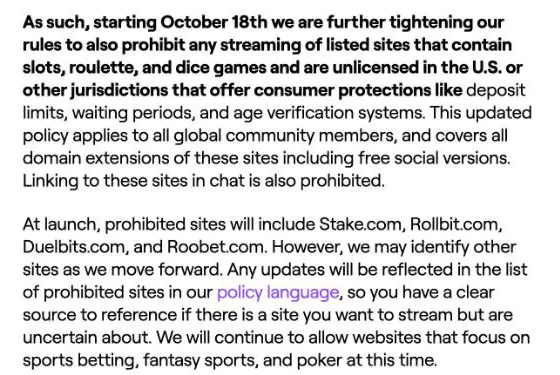
Twitch’s own post says that from 18 October 2022 it banned streams of sites with slots, roulette or dice games that aren’t licensed in the US or in places with real player protections. It named Stake, Rollbit, Duelbits and Roobet. A year earlier it had already banned links and referral codes for those games. Sports betting, fantasy sports and poker stayed allowed.
The streams didn’t stop. They moved. Kick launched at the end of 2022 and quickly became the main home for slot streams. Kick is widely reported to be backed by Stake’s co-founders, Ed Craven and Bijan Tehrani. So the biggest place to watch crypto casino streams is closely tied to one of the biggest crypto casinos.
Here’s how the story unfolded.
| When | What happened |
|---|---|
| 2016 | YouTubers TmarTn and Syndicate are revealed as owners of CSGO Lotto, a skin gambling site they had promoted in videos |
| 2017 | The US FTC settles with them over not disclosing that ownership |
| 2021 | Twitch bans sharing links and codes to slots, roulette and dice sites |
| October 2022 | Twitch bans streams of unlicensed slots, roulette and dice sites |
| Late 2022 | Kick launches and gambling streams move there |
| 2023 | xQc signs a reported $70 to $100 million Kick deal |
| March 2025 | Kick stops hourly creator pay for the Slots and Casino category |
| April 2025 | University of Sydney publishes the first study on gambling stream viewers |
| February 2026 | Bloomberg investigates win rates on Stake streams. Stake disputes it |
The CSGO Lotto case is worth remembering. The FTC said the two owners promoted the site without disclosing they owned it, and paid other influencers between 2,500 and 55,000 dollars to promote it too. It was the first FTC case against individual social media influencers. The same question still applies today. Who is really paying the person on screen?
What research says about viewers
Research on gambling streams is young, but the first results are not reassuring.
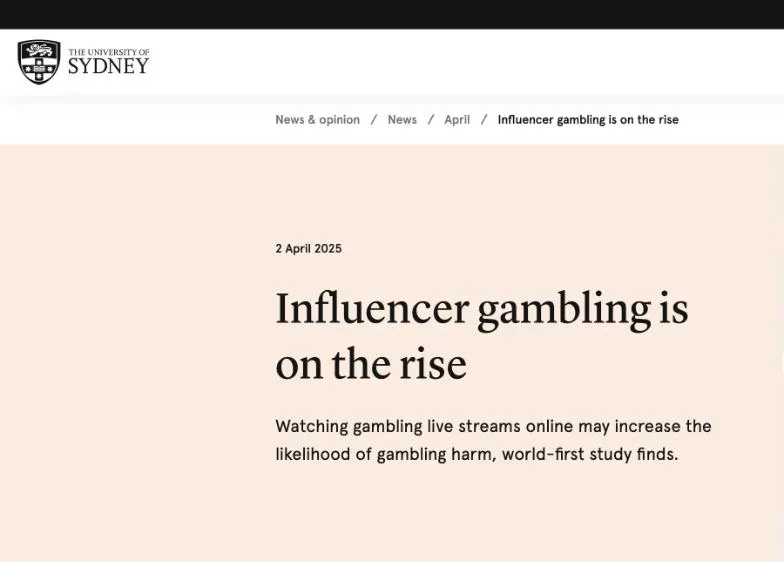
The University of Sydney study, published in April 2025, surveyed 350 viewers and watched 25 channels on Twitch and Kick. It found these things.
- Most viewers said they were more likely to gamble after watching.
- Streams often linked to gambling sites, which makes it easier to start.
- Age limits were weak, so minors could watch gambling in real time.
- Some viewers donated money so streamers would gamble with it.
- Streamers and viewers often shared wrong ideas about luck, skill and “rigged” games.
- Chat often had built-in gambling games with fake money.
The study can’t prove that watching causes gambling problems. But it shows the streams reach people, push them toward real sites and spread myths about how games work.
Red flags to watch for
- No clear statement of whose money is being played.
- A balance that only ever goes up and is never withdrawn.
- A promo code pushed hard, especially with a big deposit bonus.
- Talk of “hot” slots, “due” bonuses or systems that beat the house. None of that is real.
- Bonus buys of hundreds or thousands of dollars, every few minutes, with no sign of stress.
- Giveaways that require you to sign up or deposit somewhere.
How to watch without getting hurt
- Treat it as a show, not a lesson. The streamer’s situation is nothing like yours.
- Never copy their bet sizes. Work out what an hour would cost you using the chart above.
- Don’t sign up through a code just because you like the streamer. Check the casino first in our reviews.
- If you take a bonus from a stream, read the terms. Our guide to wagering requirements shows how to work out what it really costs.
- Set a limit before you play, and stop at it.
- If streams leave you wanting to chase losses or deposit more than you planned, take a break. Our page on responsible gambling lists tools and help.
Gambling streams can be fun to watch. Just remember the person on screen is often being paid by the casino, may not be risking their own money, and may earn more when you lose. Watch for the show, keep your own money out of it, or play only what you can afford to lose.
Questions people ask
Do gambling streamers play with their own money?
Some do and some don't, and viewers usually can't tell which. Casinos can fund a streamer's balance, add extra money on top of deposits, or pay a fee that covers losses. Several streamers have said openly that they are paid to gamble. If a stream doesn't clearly say whose money it is, assume it may not be the streamer's.
How do casino streamers make money?
Mostly from casinos, not from viewers. The main ways are flat sponsorship fees, a share of what referred viewers lose, a fixed payment for each new player, plus subscriptions and donations. The share of losses is the one to understand, because it means the streamer earns more when the people who follow their code lose more.
Are big wins on stream fake?
Most big wins are real results on real games. The issue is what you don't see. Clips show the wins, not the hours of losses before them. And when the casino pays for the balance, a big loss costs the streamer nothing while a big win still makes a great clip.
Is gambling streaming allowed on Twitch?
Partly. Since 18 October 2022 Twitch has banned streams of unlicensed sites with slots, roulette or dice games, and named Stake, Rollbit, Duelbits and Roobet. Sports betting, fantasy sports and poker are still allowed. Most crypto casino streams moved to Kick.
Who owns Kick?
Kick is widely reported to be backed by Ed Craven and Bijan Tehrani, the co-founders of Stake, through the Easygo group. Kick doesn't present itself as part of Stake, but the link is well documented in the press.
Is watching gambling streams harmful?
Research is early, but warning signs are there. A University of Sydney study of 350 viewers found most said they were more likely to gamble after watching. It also found streams often link to gambling sites and that minors can watch easily. If you notice streams making you want to deposit, that's a good moment to step back.
Should I use a streamer's promo code?
Only if you would sign up to that casino anyway, after checking it yourself. A code often means the streamer gets a cut of your losses. Read our review of the casino first, and check the bonus terms, because many streamer bonuses carry heavy wagering.