How to send crypto to a casino without losing it
Pick the right network, fill in the memo or tag, cover the fee and the minimum, and know what to do if a deposit goes wrong. Step by step, with real deposit screens.

Supply shares are from Tether’s transparency data and fees from our own snapshot of the networks, both on 9 November 2026. The other figures come from Yeet’s help page and the FBI’s 2025 crime report.
The short answer
A crypto deposit has four parts, and all four must match what the casino’s cashier shows.
- The coin. USDT is not USDC, and ETH is not BTC.
- The network. The same coin can travel on many roads. USDT moves on Tron, Ethereum, Solana and more. Pick the road the casino names.
- The address. Copy it fresh from the cashier every time.
- The memo or tag, if the cashier shows one. Leave it out and the money arrives with no name on it.
Then check two numbers. The amount must be above the casino’s minimum for that network, and you need a little extra for the network fee.
Get those right and crypto deposits are quick and boring, which is exactly what you want. Get one wrong and the money can be stuck for weeks, cost a big fee to recover, or be gone for good. Crypto payments can’t be reversed, so all the checking happens before you press Send.
Coin and network are two different things
This is the mistake behind most lost deposits, so it’s worth a minute.
Think of the coin as a parcel and the network as the courier. USDT is one parcel, but several couriers carry it. Each courier has its own depots. If you hand a Tron parcel to the Ethereum courier, it ends up in a depot the casino may never check.
Tether, the company behind USDT, publishes how much USDT sits on each network.
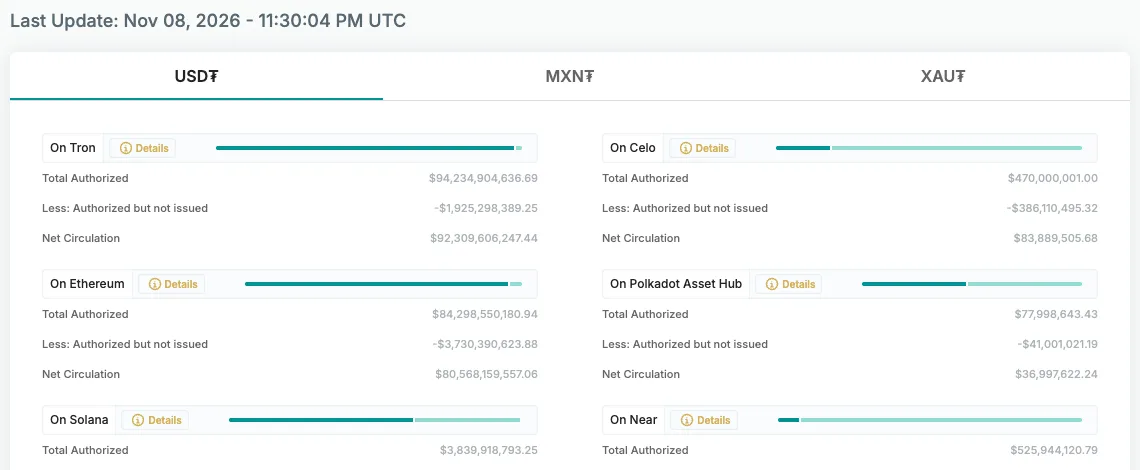
Almost all USDT lives on two networks.
Networks have nicknames, and cashiers use them all. Here’s a cheat sheet.
| What the cashier says | The network | Its own coin, which pays the fee |
|---|---|---|
| TRC-20, TRON | Tron | TRX |
| ERC-20, Ethereum | Ethereum | ETH |
| BEP-20, BSC, BNB Smart Chain | BNB Smart Chain | BNB |
| SPL, Solana | Solana | SOL |
| Polygon, POL, MATIC | Polygon | POL |
| Arbitrum, Arbitrum One | Arbitrum | ETH |
| Base | Base | ETH |
One more wrinkle. Tether lists no USDT on BNB Smart Chain at all. The USDT you see there is a token issued by Binance, not by Tether. It still works as USDT at most casinos that accept it, but it’s one more reason to send only on a network the cashier lists.
How to read a casino’s deposit screen
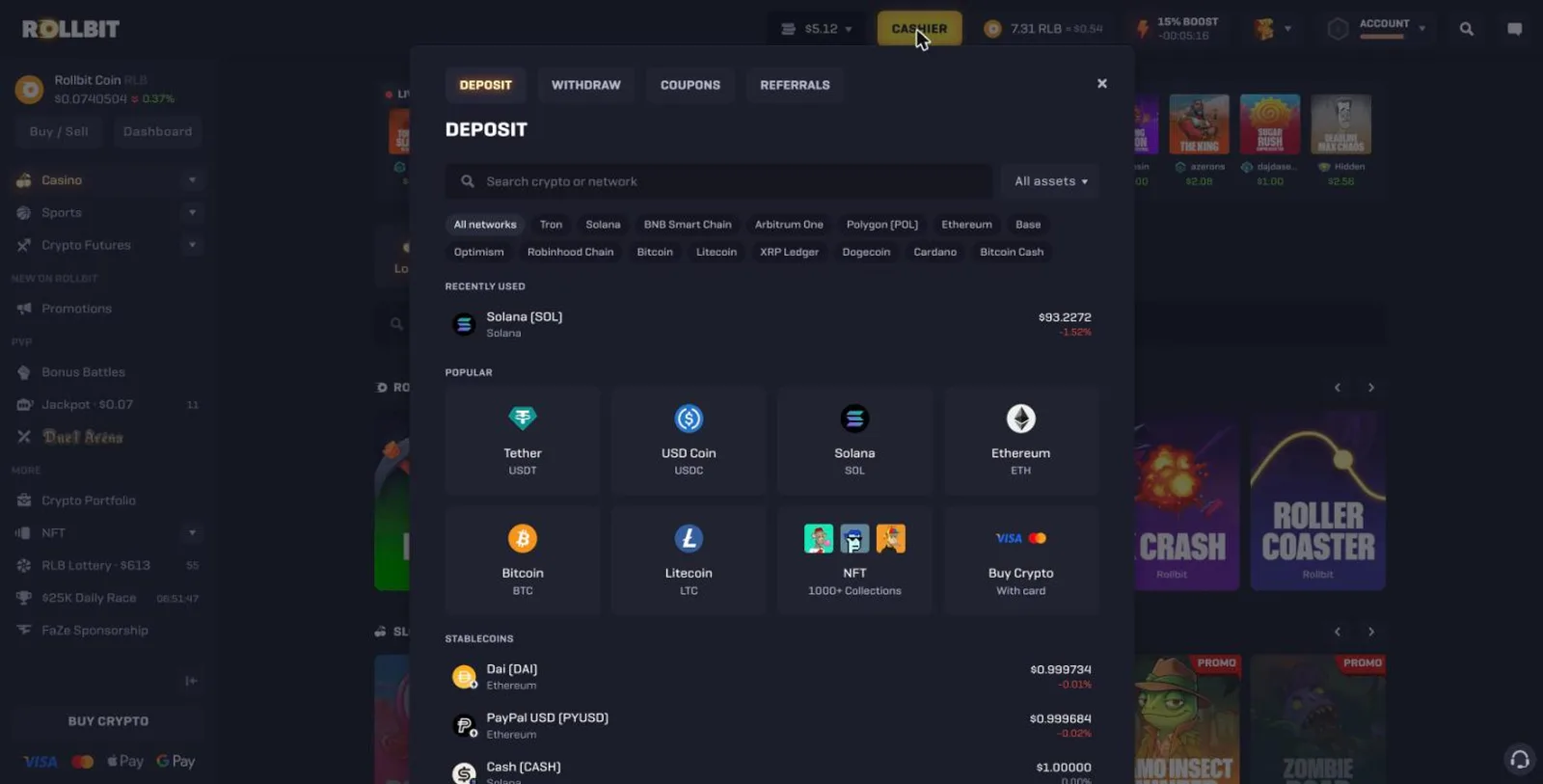
Every cashier looks a little different, but they all ask the same questions. Here’s Rollbit, which puts the network choice right at the top.
And here’s Yeet. Look at the small print under the address.
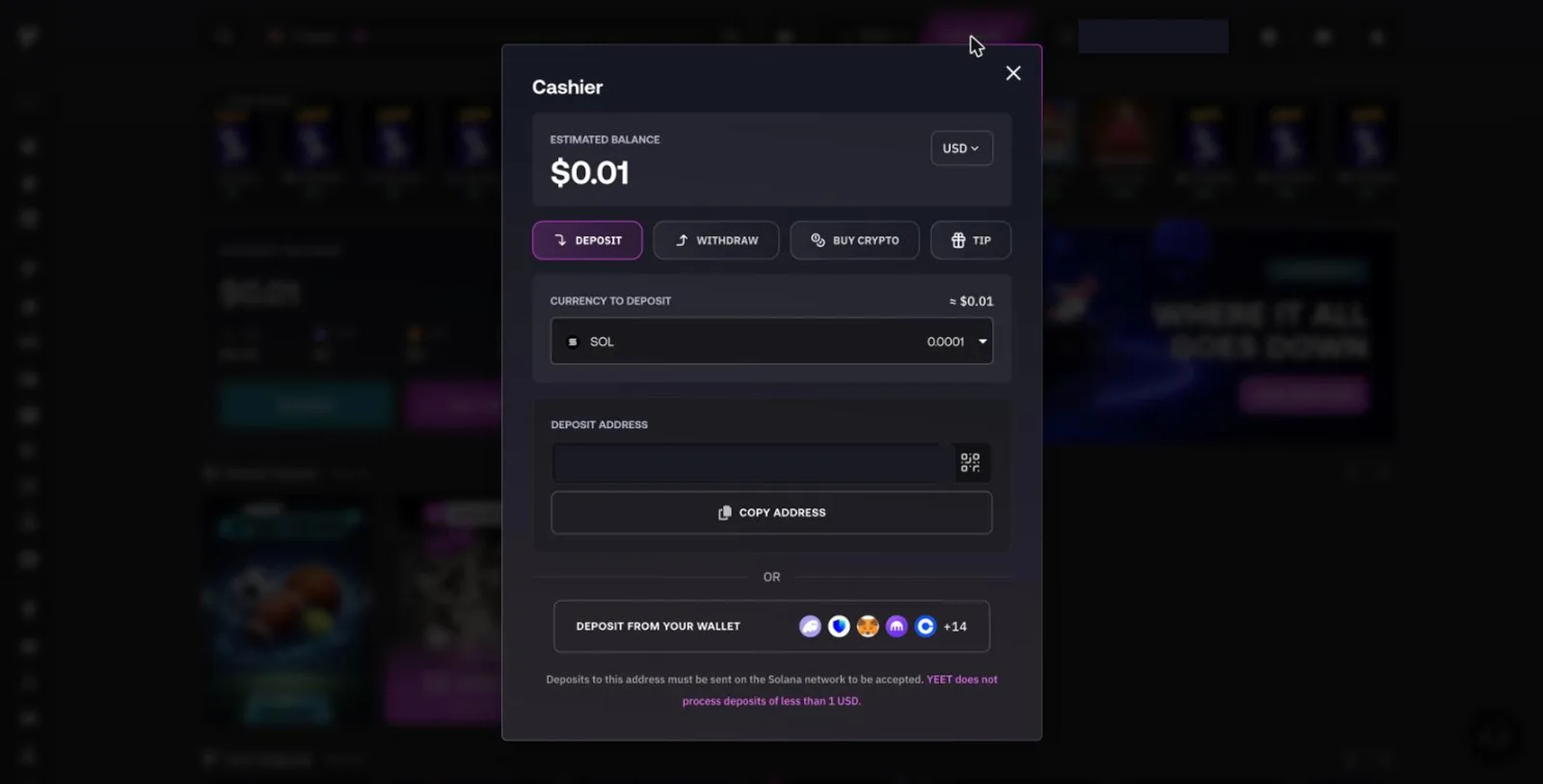
That one line holds two rules, the network and the minimum. Most people skip it. Read it every time you deposit a coin you haven’t used there before.
What to look for on any cashier.
- The coin and the network, both named. If you only see a coin, look for a network dropdown.
- The address, with a copy button and often a QR code. Use one of those, never type it.
- A memo, tag or comment field. If it’s there, it’s required.
- The minimum deposit for that network.
- Warnings in small text, like the Yeet line above.
Recognise the network from the address
Addresses look like random letters, but each network has its own pattern. This is a handy last check before you send.
| Network | The address usually starts with | Example of the start |
|---|---|---|
| Bitcoin | bc1, 1 or 3 | bc1q… |
| Ethereum, BNB Smart Chain, Polygon, Arbitrum, Base | 0x, then 40 letters and numbers | 0x71C7… |
| Tron | T, 34 characters long | TQ7m… |
| Solana | No fixed start, 32 to 44 letters and numbers | 7EcD… |
| XRP Ledger | r | rPT1… |
| Litecoin | ltc1, L or M | ltc1q… |
| TON | EQ or UQ, 48 characters | UQBv… |
Patterns come from each network’s own documentation, such as ethereum.org, the TRON docs and xrpl.org. The examples are made up.
Now the catch. Look at the second row. Ethereum, BNB Smart Chain, Polygon, Arbitrum and Base all use the same 0x style. The very same address works on all of them. So the address can’t tell you which of those networks the casino wants. Only the cashier can. This is exactly why “I sent it on BSC instead of Ethereum” is such a common mistake. Your wallet happily sends it because the address looks valid.
If you paste a Tron address into an Ethereum wallet, most wallets will refuse. That’s a good sign the networks don’t match. Don’t try to force it.
Memo, tag and comment fields
Some coins use one shared address for every customer. Think of a big office building with one street address. The memo is the apartment number. Without it, the post arrives at the building but nobody knows whose door to knock on.
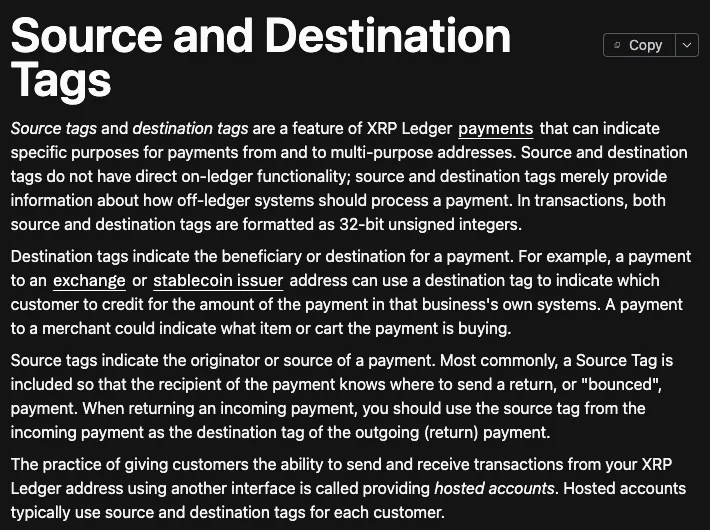
You’ll mostly meet this with XRP, Stellar (XLM) and sometimes TON. The XRP Ledger’s own documentation explains it simply.
It’s an old problem. A 2019 Stellar standard opens with the line “Users frequently forget to fill in a memo in their deposit transactions.” That’s why Stellar later added special M-addresses that carry the memo inside them.
How to get it right.
- If the cashier shows a tag or memo, copy it with the copy button, just like the address.
- In your wallet or exchange, look for a field called Memo, Tag, Destination tag or Comment. Some apps hide it under “optional”. For a casino deposit it’s not optional.
- Copy both from the same deposit screen at the same time. A tag from last month may belong to an old setup.
- Some casinos give each player a unique address instead, so there’s no memo at all. That’s fine. Don’t invent one.
And if you forget? Usually the coins reach the casino’s wallet but don’t reach your balance. Some casinos set a deadline. Casoo and Tsars say in their terms that if a destination tag is missing the deposit won’t be credited automatically, help is at their discretion, and you must contact support within 3 calendar days. Exchanges charge too. Binance’s missing memo recovery costs a network fee and takes about 7 working days.
What a deposit really costs in fees
Every network charges a small fee to move coins. The sender pays it, not the casino. Fees change through the day, so we took one snapshot of real transfers on all the main networks at the same time.
Some things here surprise people.
Tron isn’t always the cheap option any more. Tron fees are paid in something called Energy. If you don’t have any, your wallet burns TRX to pay for it. On the day we checked, one USDT send used 64,285 Energy to an address that already held USDT, and 130,285 to a brand new one. At the current price of 100 sun per Energy, that’s about 6.4 TRX or 13 TRX. A fresh casino deposit address often counts as new, so your first deposit can cost the higher amount. Exchanges and big wallets get around this with staked or rented Energy, which is why most Tron transfers we sampled didn’t burn TRX at all.
Ethereum is cheap right now, but it moves. Gas was well under 1 gwei that day, so a USDT send cost a few cents. In busy periods it has cost many dollars. Check your wallet’s fee estimate before you send.
Solana has one hidden cost. The base fee is tiny, but if the receiving address has never held that token, the sender may pay about $0.13 to set up its token account.
Your exchange’s fee is usually bigger than the network’s. If you send from an exchange, it charges its own fixed withdrawal fee, which is often more than the real network cost. Compare the exchange fee for each network the casino accepts before you pick one.
You also need the network’s own coin to pay the fee if you send from your own wallet. To send USDT on Tron you need some TRX. To send USDT on Ethereum you need some ETH. A wallet full of USDT and zero TRX can’t send anything.
Minimum deposits
Casinos set a minimum for each coin and often for each network. Send less and you may lose the lot. This isn’t rare small print. Several of the casinos we review say it plainly.
- Rollbit says in its FAQ that “deposits below the minimum for their network cannot be credited”, and that the deposit screen always shows the minimum before you send.
- Glorbet’s terms say deposits below the limit “may not reach your Account and nor can it be returned back to You”.
- Yeet shows a 1 USD floor right under its Solana address, as in the screenshot above.
MetaWin publishes a full table in its FAQ. Here’s part of it, to show how different the numbers are.
| Coin | MetaWin minimum deposit |
|---|---|
| USDT or USDC | 5 |
| BTC | 0.0001 |
| ETH | 0.002 |
| SOL | 0.05 |
| LTC | 0.08 |
| XRP | 9 |
| TRX | 40 |
From MetaWin’s FAQ, checked 9 November 2026. MetaWin says the figures may vary. Always trust the number in the cashier on the day.
Watch out for one trap. If you send from an exchange, it subtracts its withdrawal fee from the amount. Send exactly the minimum and the casino may receive slightly less than the minimum. Add a margin. Tsars’ terms add another twist for Bitcoin. If you send less BTC than requested, it says, the payment won’t process automatically and will get stuck.
How long until it shows up
Your coins need to be confirmed on the network before a casino credits them. A confirmation is the network writing your payment into a new block. Each casino decides how many confirmations to wait for, and it’s not the same for every coin. Rollbit’s FAQ, for example, says deposits are credited after network confirmation, typically within a few minutes.
For a feel of the typical wait, here are the times the exchange Kraken publishes for its own deposits.
So if a Bitcoin deposit hasn’t shown up after ten minutes, don’t panic and don’t send it again. Look up your transaction ID on a block explorer. If it’s still waiting for confirmations, it’s on its way. Bitcoin fees matter here too. A very low fee can leave a payment waiting much longer than usual.
Your checklist before you press Send
Do these every time. It takes a minute and it’s the cheapest insurance in crypto.
- Open the casino’s cashier and pick the coin and the network there first. Then pick the same network in your wallet or exchange.
- Copy the address with the copy button or scan the QR code. Never type it, and never copy it from your wallet history or an old chat.
- Copy the memo or tag too, if the cashier shows one.
- Compare the address in three places, the first few characters, the last few and some in the middle.
- Check the minimum for that network and add a margin for your exchange’s fee.
- Make sure you have the network’s own coin for the fee if you send from your own wallet.
- For a new casino or a new network, send a small amount first, above the minimum, and wait until it shows in your balance.
One warning about step 7. A test send doesn’t protect you from look-alike addresses, and it can even attract them. In December 2025 a trader lost almost 50 million USDT minutes after a 50 USDT test. A scammer had planted an address that matched the first five and last four characters, and the trader copied it from their history. For the main payment, go back to the casino’s cashier and copy the address again.
Look-alike addresses and copy-paste malware
Two tricks target exactly this moment.
Address poisoning. A scammer sends you a tiny payment from an address that starts and ends like one you use. Later you copy the wrong one from your history. TRM Labs found that on Tron the fake payment can land about 18 seconds after your real USDT transfer, worth less than a cent. On Ethereum, Chainalysis studied one campaign that set up 82,031 look-alike addresses in 66 days.
Clipboard swaps. Some malware watches what you copy and swaps a crypto address for the attacker’s. You paste without noticing.
The fix is the same for both. Copy fresh from the casino, and check the middle of the address, not only the ends. MetaMask and Ledger both give this advice. Our guide to crypto casinos on your phone has more on keeping your phone safe.
Made a mistake? What to do next
First, breathe. Then act quickly, because some casinos set deadlines.
- Find your transaction ID, also called TxID or hash. It’s in your wallet or exchange history.
- Look it up on a block explorer for that network. It tells you if the payment went through, to which address, and on which network.
- Contact the casino’s support with the TxID, the coin, the amount, the network you used, the address and the time. If you missed a memo, say which tag you should have used.
- Don’t send the same payment again until you know what happened.
What happens next depends on the mistake.
| The mistake | Can it be fixed? |
|---|---|
| Forgot the memo or tag | Often, if you contact support quickly. The coins usually reach the casino's wallet. |
| Right coin, wrong network with the same 0x address, like BNB Smart Chain instead of Ethereum | Sometimes. The coins sit at an address the casino may control on that other network. Whether it helps is up to the casino. |
| Sent less than the minimum | Often not. Rollbit and Glorbet both say such deposits can't be credited. |
| A coin the casino doesn't support | Rarely, and it may cost a lot. |
| A network with a different address style, or a wrong or mistyped address | Usually not. MetaMask's help pages say tokens sent to a non-EVM network are "likely" gone forever. |
Our reading of recovery guidance from MetaMask, exchanges and the casino terms below.
Here’s what the casinos we review say in their own terms and help pages.
| Casino | What it says about deposit mistakes |
|---|---|
| Yeet | Unsupported coins are checked case by case. If a coin can be recovered, there can be a penalty of up to 50% of the deposit. |
| Casoo and Tsars | Send only on the coin's native network or the deposit "may be permanently lost". Missing tag means contact support within 3 calendar days. Deposits straight from exchanges "could have issues". |
| Duel | Using the correct address and network is your responsibility. Duel "will not reimburse" losses from mistaken transactions. |
| MetaWin | Funds sent to a wrong address "cannot be recovered". Use the copy button and the correct network. |
| Rollbit | Deposits below the network minimum cannot be credited. |
| Glorbet | Deposits below the minimum may not reach your account and can't be returned. Tokens and smart contracts aren't supported for ETH or TRON deposits. |
| Roobet | Lists the networks for each coin and accepts nothing else. We found no published policy on refunds. |
From each casino’s terms, FAQ or help pages, checked 9 November 2026. Links to each page are in our reviews.
Some casinos do help as a goodwill gesture. On Trustpilot, a MetaWin player reported in October 2026 that a wrong-network deposit was returned minus a $5 fee. That’s one player’s report, not a promise.
Even big exchanges charge for this. Binance’s self-service recovery asks 20 USDT and about 30 working days for tokens sent on an unsupported EVM network, and says recovery is “not guaranteed”. Kraken charges a network fee for a missing tag and 500 USD for an unlisted asset on an unsupported network. A casino has less reason to help than an exchange, so prevention is far better than cure.
Watch out for “recovery” scams
After a mistake, people search online for help. Scammers wait there. They pose as recovery experts, hackers, lawyers or even police, and ask for a fee up front.
The FBI’s 2025 Internet Crime Report counted 10,516 complaints about recovery scams and $1.4 billion in losses. The FBI notes this can include money lost in the earlier scam. The US Federal Trade Commission warns that these scammers “buy lists of people who’ve already been scammed”.
The rule is simple. Only the casino or exchange that holds the wallet can move those coins. Nobody else can pull them back from the blockchain. If someone contacts you offering to recover crypto for a fee, it’s a scam.
If a casino refuses to help with a real problem, our guide on what to do when a casino won’t pay walks through your options.
Quick recap
- Coin and network are different. Match both to the cashier.
- Copy the address and any memo with the copy button, fresh every time.
- Check the minimum for that network and leave room for fees.
- Keep a little of the network’s own coin for the fee.
- Test with a small amount at a new casino, then copy the address fresh again.
- If something goes wrong, contact support at once with your transaction ID.
- Never pay a stranger to “recover” crypto.
Want to know which coins and networks each casino takes? Our casino reviews list them, and our coin pages like Tether and Tron explain how each network works. Deposit only what you can afford to lose. Our page on responsible gambling has tools that help.
Questions people ask
What happens if I send USDT on the wrong network?
The coins leave your wallet but don't show up in your casino balance. Whether you get them back depends on the casino. If both networks use the same kind of address, like Ethereum and BNB Smart Chain, the casino may be able to recover them, often for a fee. If the networks are very different, the money is usually gone. Contact support at once with the transaction ID.
Which network is best for sending USDT to a casino?
The one the casino's deposit page names for the address you copied. After that, cost matters. On 9 November 2026 a USDT send cost less than a cent on Solana, BNB Smart Chain and Polygon, a few cents on Ethereum, and about $2 to $4 on Tron if you pay the fee by burning TRX. Exchanges often charge their own fixed fee on top.
What is a memo or destination tag?
A short number or text that tells the casino which player a payment belongs to. Coins like XRP, Stellar and sometimes TON use one shared address for many customers, so the tag is how your deposit finds your account. If the cashier shows a tag or memo, you must enter it.
I forgot the memo. Is my money lost?
Not always, but act fast. The coins usually reach the casino's wallet, they just aren't matched to you. Contact support with the transaction ID, amount and time. Casoo and Tsars say you must do this within 3 calendar days, and help is at their discretion.
What if I send less than the minimum deposit?
Many casinos won't credit it. Rollbit says deposits below the network minimum cannot be credited. Glorbet's terms say they may not reach your account and can't be returned. Always check the minimum on the deposit screen for the network you picked.
Should I send a small test amount first?
It's a good habit for a new casino or a new network, as long as it's above the minimum. But a test doesn't protect you from look-alike addresses. Scammers sometimes watch for test sends. Copy the address fresh from the casino for the main payment too.
Someone says they can recover my lost crypto for a fee. Should I trust them?
No. Recovery scams cost Americans $1.4 billion in 2025, according to the FBI. The US Federal Trade Commission warns that these scammers buy lists of people who have already lost money. Only the casino or exchange that holds the wallet can help.