RTP, house edge and volatility explained simply
What a game's RTP really tells you, why the same slot can pay back less at one casino than another, how volatility changes your session, and how to check the number yourself.

What RTP means, in plain words
RTP stands for return to player. It’s the share of all the money bet on a game that the game pays back as wins, over a very long time.
Think of a vending machine that takes 100 coins and gives back 96. You’ll never notice it on one go. Sometimes you get lucky and it gives back more. But over millions of goes, the machine keeps 4 of every 100.
That 4 is called the house edge. It’s just the other side of RTP.
- 96% RTP means a 4% house edge.
- 99% RTP means a 1% house edge.
- 88% RTP means a 12% house edge.
The higher the RTP, the slower your money goes on average. That’s all it is. It’s not a promise, and it’s not a chance of winning.
What RTP does not mean
This is where most people get it wrong.
- It does not mean you get 96 euros back from your 100. Your session could end at zero or at 500.
- It is not your chance of winning a spin. A 96% slot does not win 96% of the time.
- It does not even out in one evening. The number is worked out over millions of spins, far more than anyone plays.
- It does not make a game “due”. Every spin is random and has no memory.
The easiest way to use RTP is as a price tag. It tells you what playing costs on average, not what will happen tonight.
How to work out what a game costs you
There’s one simple sum.
Total you bet × house edge = what you lose on average.
Here’s an example. You play 500 spins at 1 euro each. That’s 500 euros of bets, even if you only deposited 50 and kept spinning your wins. On a 96% slot the house edge is 4%, so the average cost is about 20 euros.
Notice that the total you bet grows much faster than your deposit. That’s why long sessions cost more than people expect. Our guide on gambling streamers shows what an hour costs at different bet sizes.
The same slot can have several RTPs
Here’s the part most players don’t know. Many game studios make the same slot in several RTP versions. The casino picks which one it runs. The game looks and sounds exactly the same in every version.
Hacksaw Gaming is one of the few studios that shows all of them on its own website.
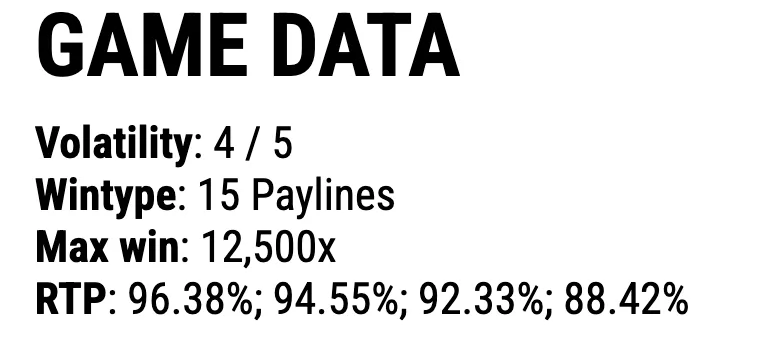
So what does that gap cost you? Here’s the average loss on the same 1,000 euros of bets in each version.
The lowest version takes about three times as much of your money as the highest. Same game, same graphics, same bet.
Other studios show less.
- Pragmatic Play lists one RTP per game on its pages, like 96.50% for Gates of Olympus and 96.48% for Sweet Bonanza. Casinos may still run a lower version.
- Big Time Gaming shows a range for some games, like Extra Chilli at 96.15% to 96.41%. A range means there’s more than one version.
- Play’n GO’s official Book of Dead page shows no RTP at all. The game is widely reported to come in several versions.
You can read more on each studio in our providers guide.
How to check the RTP yourself
Don’t trust the number on a review site, ours included. Check the game at your casino.
- Open the slot.
- Tap the info button, the “i”, or the menu icon.
- Open the rules or the paytable.
- Scroll down. The RTP is usually near the bottom, often written as “theoretical RTP” or “return to player”.
If you can’t find it, that’s useful to know too. Some games also list a different RTP for the bonus buy feature, so check that line if you buy bonuses. If the number is well under 96%, you’re playing a version that keeps more of your money.
House edge in other casino games
Slots aren’t the only games with a house edge. Table games have one built into their rules and payouts, and it’s often lower.
A few things to notice.
- European roulette has one zero, so the house edge is 2.70%. American roulette adds a double zero and the edge almost doubles to 5.26%. Always pick the single zero wheel if both exist.
- Blackjack is only cheap if you play it well. Guessing or following hunches costs far more than 0.5%.
- In live game shows like Crazy Time, the RTP changes with the spot you bet on. Evolution gives a range from 94.41% to 96.08%.
- A low RTP version of a slot can cost more than four times as much as European roulette.
Some crypto casinos run their own simple games, called originals, with very low edges. Duel’s Dice, for example, pays 2x at a 49.95% chance. That’s 99.9% before rakeback, and Duel says its rakeback brings the net edge to zero up to a daily allowance. Read our Duel review for the catches.
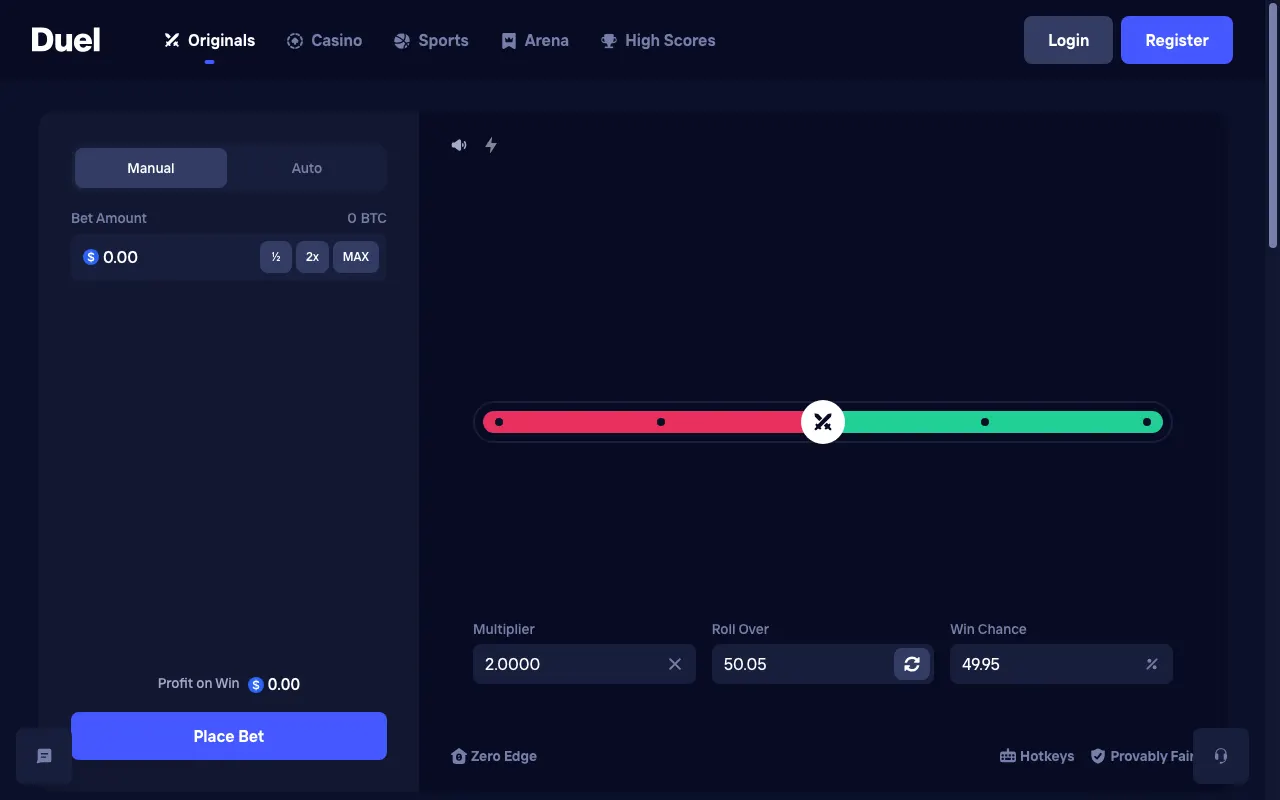
Many of these games are also provably fair, which means you can check each result yourself. Our guide to provably fair games explains how.
Volatility, the thing RTP doesn’t tell you
RTP tells you how much a game pays back. Volatility tells you how it pays back.
- Low volatility games pay small wins often. Your balance goes up and down gently.
- High volatility games pay nothing or very little most of the time. Then, once in a long while, they pay a huge win.
Both can have exactly the same RTP. They just feel totally different. Hacksaw rates Wanted Dead or a Wild 4 out of 5 for volatility, so it’s at the wild end.
To show what this means, we simulated 20,000 players. Each one starts with 100 euros and plays 500 spins of 1 euro, or until the money runs out. Half play a made-up low volatility slot, half a made-up high volatility slot. Both slots have a 96% RTP.
Same RTP, very different evenings.
- On the low volatility slot, almost nobody went broke. Most players lost a bit, and about 1 in 4 ended ahead.
- On the high volatility slot, about 9 in 10 players lost all 100 euros. A few hit a big win, and the luckiest ended with over 3,000 euros.
That’s how high volatility slots work. The big wins you see in screenshots and on streams are real, but they’re paid for by the many players who got nothing. If you have a small balance, a high volatility game will often eat it before anything exciting happens.
Bonus rounds, bonuses and RTP
RTP matters most when you bet a lot of money in total, and bonuses make you do exactly that.
A bonus with wagering requirements makes you bet the bonus many times over. Every one of those bets pays the house edge. On a 96% slot, 5,000 euros of wagering costs about 200 euros on average. A slot with a lower RTP version costs even more. Our guide to wagering requirements does the full sums.
Rakeback works the other way. It pays you back a part of the house edge on every bet, so it raises your real RTP a little.
Myths about RTP
- “This slot is hot right now.” It isn’t. Results are random and past spins don’t change the next one.
- “The casino lowers the RTP when I’m winning.” In a properly tested game, the RTP version is set in the game’s settings, not changed spin by spin. What a casino can do is pick a low version from the start. That’s why you check the info screen.
- “Higher bets get a better RTP.” Usually not. The RTP is normally the same at every bet size. If it isn’t, the rules say so.
- “A 97% slot means I’ll win more often.” Not necessarily. A high RTP slot with high volatility can still lose most sessions.
Tips that save money
- Check the RTP in the game’s info screen before you play. Skip versions well under 96%.
- Prefer European roulette over American roulette.
- Learn basic strategy before you play blackjack, or the low edge doesn’t apply.
- If your balance is small, pick low volatility games. They last longer.
- Count your total bets, not just your deposit. That’s the number the house edge works on.
- Treat RTP as the price of fun, not a way to make money. Set a limit and stick to it. Our page on responsible gambling has tools that help.
RTP won’t tell you whether you’ll win tonight. Nothing can. But it tells you what playing costs, and that’s worth knowing before you spin. Pick games that are honest about it, and casinos that run the better versions. Our casino reviews are a good place to start.
Questions people ask
What does 96% RTP mean?
It means the game pays back about 96 of every 100 euros bet, averaged over millions of spins by all players. The other 4 euros is the casino's share, called the house edge. It does not mean you get 96 euros back from your own 100.
Can I win on a game with a low RTP?
Yes. RTP is a long-run average, so anyone can win or lose in a short session. A lower RTP just means you lose a bit more on average the longer you play.
Can the same slot have a different RTP at different casinos?
Yes, and it's common. Many providers make several versions of the same game and the casino picks one. Hacksaw lists four versions of Wanted Dead or a Wild, from 96.38% down to 88.42%. The game looks the same in every version.
How do I find the RTP of a slot?
Open the game, tap the info or menu button and look in the rules or paytable. The RTP is usually written near the bottom. That's the number for the version your casino runs, which matters more than the number on a review site.
What is the difference between RTP and volatility?
RTP is how much a game pays back on average. Volatility is how that money is paid out. Low volatility pays small wins often. High volatility pays nothing for long stretches, then sometimes a big win. Two games can have the same RTP and feel completely different.
Which casino game has the lowest house edge?
Blackjack played with perfect basic strategy is usually the lowest, at around 0.5% depending on the table rules. Baccarat on the Banker bet is about 1.06%. European roulette is 2.70%. A 96% slot is 4%, and low RTP versions can reach 12% or more.
Is a slot ever due to pay out?
No. Each spin is random and doesn't remember the last one. A slot that hasn't paid for an hour is no more likely to pay on the next spin.